Exploring the comets with Rosetta Jérémy Lasue

le 09 oct 2015 de10h00à 12h002015/10/09 2015/10/09
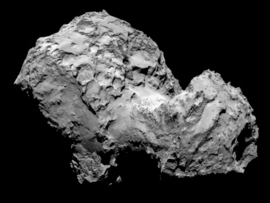
Comet 67P by Rosetta's OSIRIS narrow-angle camera on 3 August 2014. Credit: ESA/Rosetta/MPS for OSIRIS Team MPS/UPD/LAM/IAA/SSO/INTA/UPM/DASP/IDA

Since the beginning of the space age, our knowledge of the solar system icy bodies has greatly improved. New ice physics processes have been unveiled on the surface of comets and icy satellites. Primordial reservoirs (like the Kuiper belt) have been discovered and are getting further analyzed, by either ground or space-based observations. Numerous space missions are revealing the nature and properties of comets, small bodies enriched in water and complex organic molecules that could have favored the apparition of life on Earth. This talk will describe our current knowledge of the solar system icy bodies and more particularly the comets, in the wake of the Rosetta space mission. The current discoveries of Rosetta at 67P/Churyumov-Gerasimenko will be detailed together with their implications on the formation of planetary systems.

Plus d'actualités

Geopolitics of Space Exploration

by Sylvestre Maurice, Friday November 27th in Room Jules Verne (Belin site) at 10h45 Summary: (to be added later)

Ground-based facilities for French astronomers

Geneviève Soucail, Friday November 20th in Room Jules Verne at 10h45 (Belin site) Summary: « I will present an overview of the observational resources currently available in French astronomy, as well as future projects. This overview covers telescopes and instruments in the optical-IR and radio-submillimeter bands. These facilities are generally established as part of large international […]

Euclid: Probing the Dark Sides of the Universe

Le 13 novembre 2026, Alain Blanchard, 10h45 à 12h45, Salle Jules Verne, OMP, site Belin Summary: Over the course of the twentieth century, cosmology revealed the presence of an unknown form of matter, undetectable on Earth or in laboratories: dark matter, which in fact constitutes the main material component of the Universe. But over the […]

Rechercher