Séminaire

Results from the James Webb Space Telescope

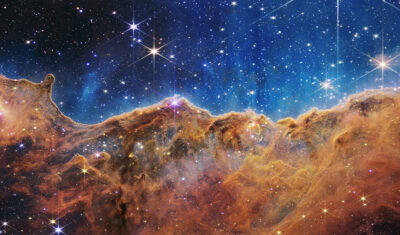
le 6 octobre 2023, 10h45 à 12h45, Oliver Berné, salle Jules Verne, OMP, site Belin Resumé: In this seminar, I will present the first scientific results that have been obtained from the JWST mission. After a general presentation of the mission and science results on various topics, I will describe the Early Release Science (ERS) project […]
30.08.2023

The first stars and galaxies : new insights from the James Webb Space Telescope

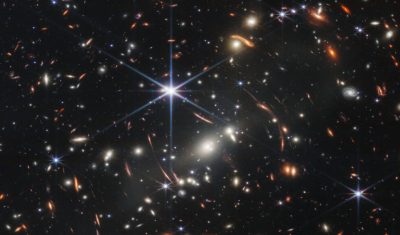
le 29 septembre 2023, 10h45 à 12h45, Nicolas Laporte, salle Jules Verne, OMP, site Belin Resumé:  One of the most intriguing topics in modern extragalactic astronomy is the quest to understand when the first generation of stars and galaxies bathed the Universe in light. This quest for Cosmic Dawn began in the 1950s and has […]

Environmental and social issues in astronomy and research in general

le 22 septembre 2023, 10h45 à 12h45, Angèle Mouinié, salle Jules Verne, OMP, site Belin Resumé: 

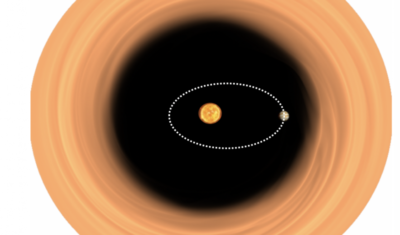
Why are warm Jupiters so eccentric ?

le 15 septembre 2023, 10h45 à 12h45, Florian Debras, salle Jules Verne, OMP, site Belin Resumé: With more than 5000 exoplanets discovered, we have access to numerous statistics which represent the condition of formation and evolution of planetary systems. One of such statistics is the eccentricity distribution of warm Jupiters: planets around the mass of Jupiter, […]

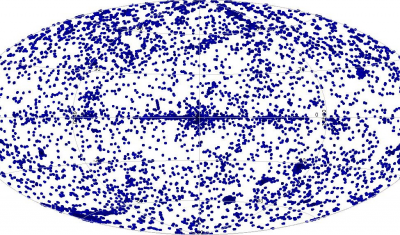
Searching for new and rare objects in the Universe

le 8 septembre 2023, 08h30 à 10h15, Natalie Webb, salle Jules Verne, OMP, site Belin Resumé: Thanks to large surveys such as Gaia, the Sloan Digital Sky Survey (SDSS), GALEX, 2MASS, NVSS, FIRST, XMM-Newton and Chandra, we have catalogued many different stars and galaxies. We have also found some very exotic objects, especially when we observe […]

A Universe of Waves

le 1 septembre 2023, 11h à 13h, Arturo Lopez, salle Jules Verne, OMP, site Belin Resumé: The phase of a wave can only be defined unambiguously for complex waves. This strange quantity appears at the core of all physics: from the quantification of atomic levels or of the electric charge to the source of the electromagnetic […]

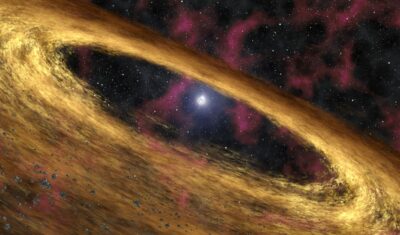
The ultimate fate of planetary systems

le 28 octobre 2022, 11h à 13h, Sylvie Vauclair, salle Jules Verne, OMP, site Belin The formation and evolution of planetary systems are important subjects. But what about their ultimate fate, when their host stars evolve as red giants, lose their gaseous envelopes as planetary nebulae, and end their lives as white dwarf stars? Recent […]

09.09.2022

The physics of accretion at its extreme: Ultraluminous X-ray sources

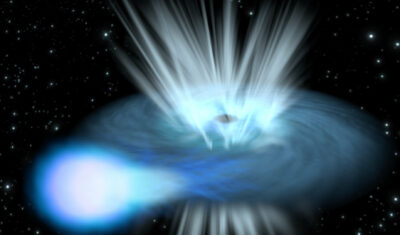
le 9 décembre 2022, 11h à 13h, Roberta Amato, salle Jules Verne, OMP, site Belin Ultraluminous X-ray sources (ULXs) are amongst the brightest extra-galactic objects in the X-ray sky. They are characterized by luminosities well above the Eddington limit, the maximum possible luminosity reached when the radiation pressure and the gravitational force are in equilibrium. […]

29.08.2022

Why are warm Jupiters so eccentric ? 

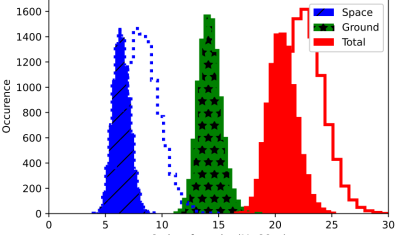
le 16 décembre 2022, 11h à 13h, Florian Debras, salle Jules Verne, OMP, site Belin With more than 5000 exoplanets discovered, we have access to numerous statistics which represent the condition of formation and evolution of planetary systems. One of such statistics is the eccentricity distribution of warm Jupiters: planets around the mass of Jupiter, […]

Rechercher