The quest for the Cosmic Microwave Background B-modes, Jonathan Aumont
le 29 nov 2019 de 11h00 à 13h00


le 29 nov 2019 de 11h00 à 13h00
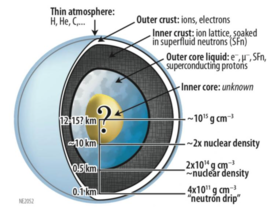
Le 22 nov 2019 de 11h00 à 13h00 Neutron stars are the extremely dense compact remnants of supernova explosions. Their properties makes them wonderful objects to study the behaviour and composition of matter in regimes not accessible by Earth laboratories (densities beyond the nuclear densities, ~2×10¹⁴ g/ cm3). Determining the dense matter equation of state, […]
le 15 nov 2019 de 11h00 à 13h00
Thanks to large surveys such as Gaia, the Sloan Digital Sky Survey (SDSS), GALEX, 2MASS, NVSS, FIRST, XMM-Newton and Chandra, we have catalogued many different stars and galaxies. We have also found some very exotic objects, especially when we observe at high energies, where we detect matter at very high temperatures around black holes, neutron […]
le 18 oct 2019 de 11h00 à 13h00 Supermassive black holes (SMBHs; masses of ≳10^6M⊙) lie at the center of most (if not all) galaxies. As they grow via accretion, as active galactic nuclei (AGN), they become thousands of times brighter than the galaxies that host them. As a result, they have a dramatic impact […]
le 11 oct 2019 de 11h00 à 13h00
le 04 oct 2019 de 11h00 à 13h00

le 27 sept 2019 de 11h00 à 13h00
le 13 sept 2019 de 11h00 à 13h00