
Rosetta: 2 years of studying comet 67P/Churyumov-Gerasimenko Jérémie Lasue
le 07 oct 2016 de11h00à 13h002016/10/07 2016/10/07
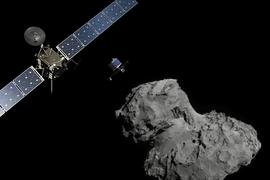
Comets are icy bodies remnants of the earliest moments of the solar system formation and that are now studied in details by space missions. The most recent spacecraft, Rosetta, will end its studies in September 2016 after having landed Philae for the first time on the surface of a cometary nucleus and followed 67P on its orbit for more than two Earth years. The on-board scientific instruments have demonstrated the chaotic behavior of the cometary activity as a function of its orbital properties. Cameras have unveiled an irregular surface prone to erosion and deposition of dust, with few spots of ice detected on its surface. Dust particles detectors have shown that two types of solid particles are ejected by the nucleus, one being dense and compact grains and the other being very fluffy irregular dust particles. No specific structures inside the cometary nucleus were detected by instruments sounding inside the nucleus, and the very low density of the cometary material (0.5 g.cm-3) remains difficult to explain. Gaseous particles ejected by the comet contain a high fraction of O2 and complex carbonaceous molecules like glycine, an amino acid that was first detected in situ by Rosetta.
We will review the results from the whole Rosetta/Philae mission and describe in details what we have learned about these objects.

