Why are warm Jupiters so eccentric ?
le 16 décembre 2022, 11h à 13h, Florian Debras, salle Jules Verne, OMP, site Belin
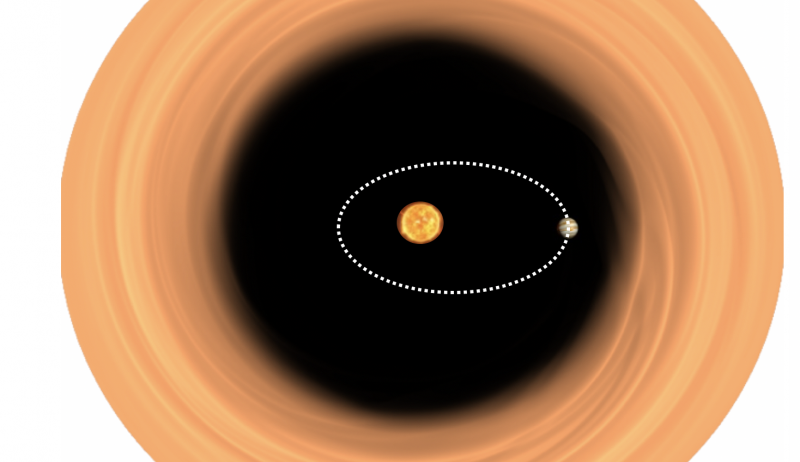
With more than 5000 exoplanets discovered, we have access to numerous statistics which represent the condition of formation and evolution of planetary systems. One of such statistics is the eccentricity distribution of warm Jupiters: planets around the mass of Jupiter, with orbital period between 100 and 1000 days appear to have a mean eccentricity much higher than the rest of the planets (around 0.25). Although some explanation invoking planet-planet scattering have been put forward, they fail at reproducing all observational constraints and notably predict unseen companions. In 2021 in IRAP, we proposed that a peculiar migration history for giant planets can explain this trend: we have shown that, as the planet migrates in the protoplanetary disc where it formed, it can fall into a cavity of gaz. Inside this cavity, the nature of the gravitational forces exerted by the gaz onto the planet change in magnitude, and lead to an eccentric instability: the planet naturally gets eccentric without the need of a companion. During this seminar, I will explain the physics of this peculiar migration history and detail its observational consequences. I will also show the implication for our understanding of the formation and evolution of extrasolar planets.