
Accretion disks in astrophysics: How can black holes shine brighter than a million Suns? Filippos Koliopanos
le 24 nov 2017 de11h00à 13h002017/11/24 2017/11/24
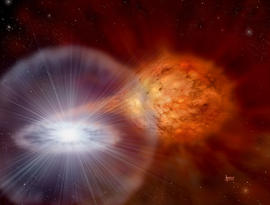
When stars die, they leave behind a relativistic « relic ». A white dwarf, a neutron star or a black hole. Made out of ultra-dense material and supported by electron and neutron-pressure respectively, white dwarfs and neutron stars are tiny, faint objects, while black holes are bounded by an event horizon, beyond which radiation cannot escape. However, under the right circumstances these objects can become some of the brightest sources in the universe, exceeding the luminosity of the sun by millions of times. This colossal energy release is achieved when the compact objects form a binary system with a secondary normal star, which (under the right circumstances) is gradually ripped apart and consumed in a process known as accretion. The accretion disk (see Fig.1) that forms around the black holes (or neutron stars), is the most efficient mechanism of mass-to-energy conversion in the universe, producing radiation in the entire electromagnetic spectrum. In this seminar I will review all the different types of accreting binaries, with a focus on X-ray binaries. I will examine the different physical mechanisms that underlie the creation of these exotic objects, the processes that produce their emission and all the different complexities that arise from (e.g.) the presence of magnetic fields in neutron stars or the creation of jets in black hole binaries. Lastly, I will discuss all the latest developments in the field and present currently unsolved problems which are waiting to be addressed by the next generation of students and young researchers.

