The origins of hot Jupiters Louise Yu

le 01 déc 2017 de11h00à 13h002017/12/01 2017/12/01
The origins of hot Jupiters

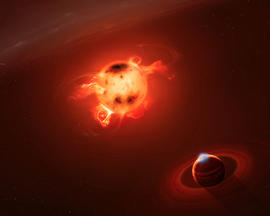
How do planetary systems form? Ever since the search for exoplanets started more than twenty years ago, over 3000 exoplanets have been detected, with a diversity going far beyond that of our own solar system. Among them, hot Jupiters, planets as massive as Jupiter or more, but orbiting their star very closely, are a key to understanding how planets form and migrate in their early years (or rather, early millennia). Indeed, models show that such massive planets have formed far from their star and then migrated inwards, impacting on the global choreography of the planetary system through their important gravitational influence. In order to discover the mechanisms leading to this migration, we observe sun-like stars that are at the beginning of their life, only a few million years old, look for exoplanets around them and study their characteristics. This seminar will elaborate on planet migration, on some exoplanet detection techniques, in particular around young sun-like stars, and on some recent results and future prospects.

Plus d'actualités

Measuring distances in astrophysics

le 4 septembre 2026, 10h45 à 12h45, Katia Ferrière, salle Jules Verne, OMP, site Belin Summary: I will take you on a cosmic journey from the Earth to the far reaches of the observable Universe. We will first spend some time in the solar system, where I will show how the radius of the Earth […]

A Universe of Waves

le 11 septembre 2026, 10h45 à 12h45, Arturo Lopez-Ariste, salle Coriolis, OMP, site Belin Summary: The phase of a wave can only be defined unambiguously for complex waves. This strange quantity appears at the core of all physics: from the quantification of atomic levels or of the electric charge to the source of the electromagnetic […]

Finding new and extreme objects in the Universe

le 18 septembre 2026, 10h45 à 12h45, Natalie Webb, salle Jules Verne, OMP, site Belin Summary: Thanks to large surveys such as those carried out with Gaia, Pan-STARRS, the Sloan Digital Sky Survey (SDSS), 2MASS, NVSS, XMM-Newton and Chandra, we have catalogued many stars and galaxies, as well as exotic objects, especially when we observe […]

Rechercher